Thrinacia Fabric is taking a major step forward and bringing idea we had longer ago to reality.
With our August 14 release cycle, Fabric is evolving from a fundraising infrastructure platform into a unified fundraising and e-commerce infrastructure platform. Fundraising and commerce are now independent modules that can be enabled separately or operated together within the same deployment.
This creates a model that goes beyond simply adding a store to a fundraising platform.
Organizations can now use Fabric to operate a dedicated fundraising platform, a dedicated e-commerce platform, a fundraising or commerce marketplace, or a hybrid platform combining both models.
More importantly, products can move naturally between fundraising and commerce. A company can launch a product through a crowdfunding or presale campaign, validate demand and accept early orders, and then transition that same product into ongoing e-commerce sales without moving customers, payment infrastructure, inventory, or operations to another platform.
Combined with the expanded Thrinacia Fabric MCP 0.3.0, unified payments, marketplace infrastructure, inventory management, and more than 300 API operations, Fabric is becoming a highly flexible infrastructure layer for building fundraising, commerce, marketplace, and AI-driven transactional applications.
Fundraising and Commerce Are Now Independent Modules
Fabric deployments can now be configured around the business model of each organization.
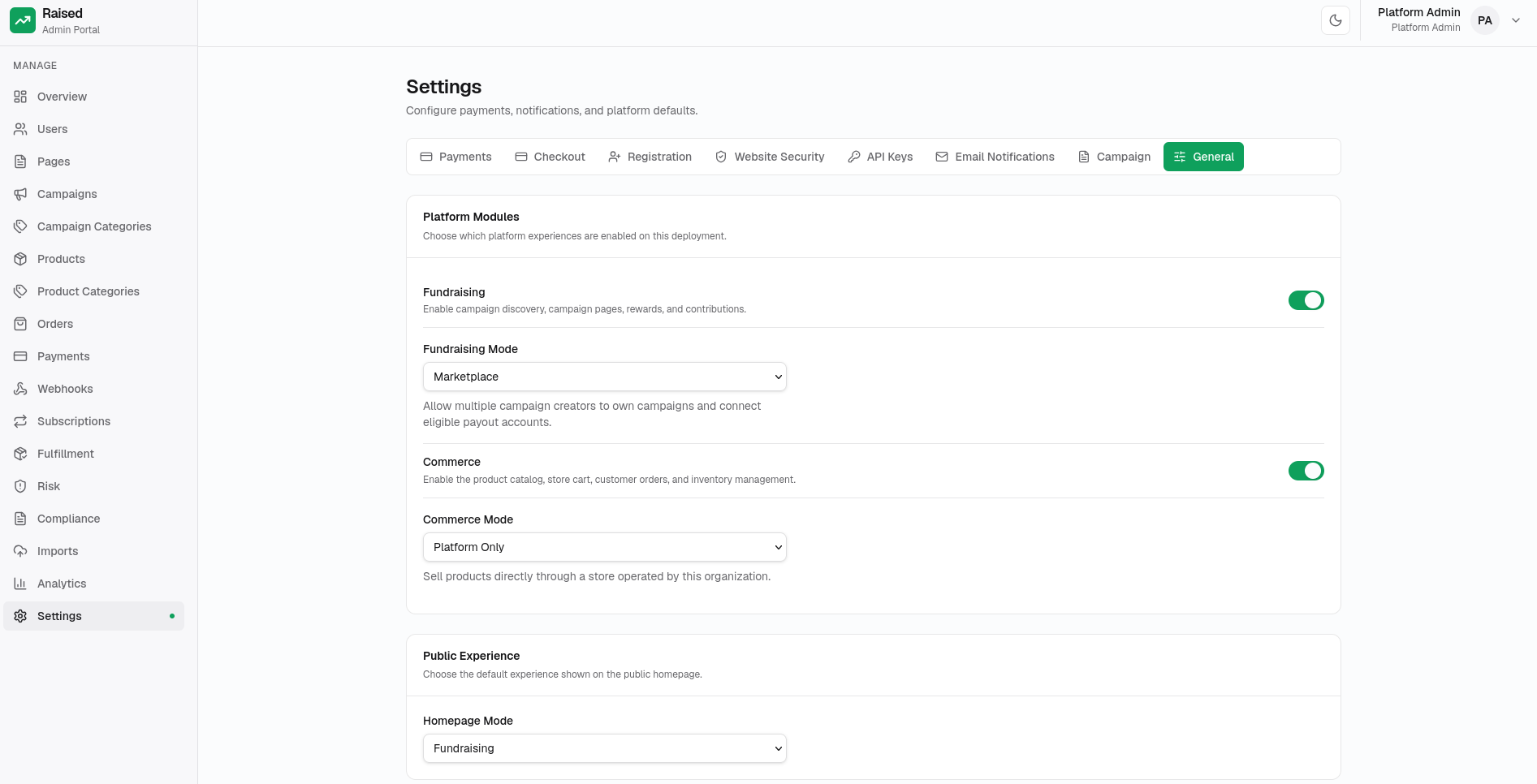
Administrators can independently enable Fundraising and Commerce, while each module can operate in either:
- Platform Only mode — products or campaigns are operated directly by the platform.
- Marketplace mode — third parties can participate as campaign owners, sellers, or vendors.
The public homepage can also operate in Fundraising, Store, or Fundraising And Store mode.
Navigation automatically adapts to the enabled modules, allowing organizations to create very different businesses from the same Fabric infrastructure.
Fundraising remains enabled by default, while Commerce can be activated when required. These settings are available through both Admin Settings and the Fabric API.
This means Fabric can now power use cases ranging from a traditional crowdfunding portal to a standalone online store, multi-vendor marketplace, or a platform combining all of these capabilities.
From Crowdfunding Presale to E-Commerce
One of the most important capabilities introduced by the new architecture is the connection between campaign rewards and commerce products.
Product variants can be associated with campaign reward tiers, while inventory can be shared or allocated between campaigns and the store.
Consider a company launching a new physical product.
Instead of establishing separate crowdfunding and commerce systems, the company can use Fabric to:
- Launch the product as a fundraising or presale campaign.
- Offer different product variants as campaign reward tiers.
- Accept presale orders through Fabric’s fundraising checkout.
- Track inventory and allocations during the campaign.
- Complete the fundraising or presale stage.
- Continue selling the same product through the Fabric Store.
Organizations can also operate both models simultaneously.
A product might be available through an active campaign while other established products are sold through the store. A platform could host fundraising campaigns from creators while simultaneously operating a multi-vendor marketplace.
The fundraising-to-commerce lifecycle becomes part of the platform rather than requiring an external migration.
A New E-Commerce Foundation
Fabric now includes a substantial commerce infrastructure layer covering products, variants, categories, inventory, carts, checkout, orders, shipping, tax, discounts, fulfillment, returns, refunds, digital products, and reporting.
Product management includes configurable SKUs, pricing, shipping requirements, publication status, images, digital assets, variants, automatic slugs, duplicate-slug protection, category filtering, and drag-based ordering.
Product and campaign categories are maintained independently, giving administrators control over two different discovery structures.
Public commerce routes now include:
/store/store/product/{slug}/cart/account/orders
Categories support Draft and Published visibility, while products and categories can be reordered directly from the administrative interface.
Inventory Designed for Both Campaigns and Commerce
Inventory becomes especially important when fundraising and commerce coexist.
Fabric now includes an inventory ledger and adjustment history along with multiple inventory policies.
Inventory tracking is optional by default, but organizations can enable tracked shared inventory or campaign allocation policies where required.
Fabric can control overselling and out-of-stock behavior and generate low-inventory notifications.
Most importantly, campaign reward tiers can reference product variants.
That creates a shared product model where a product can begin as a crowdfunding reward or presale item and later continue as a normal store product.
Cart, Checkout and Secure Payments
Fabric now provides a persistent single-store shopping cart and a complete commerce checkout workflow.
The platform supports cart quoting before an order is created, followed by order creation using short-lived checkout links. Inventory can be temporarily reserved while payment is pending, and abandoned pending orders automatically expire.
Payment initialization, completion, and status tracking are integrated directly into the commerce workflow.
Fabric continues to follow a tokenized payment architecture. Payment provider sessions handle sensitive payment information, and raw card numbers and CVV values are not accepted through either the Fabric API or MCP.
The same payment gateway infrastructure can now serve both fundraising and commerce, reducing the need to build and maintain separate payment systems for each business model.
Complete Commerce Operations
The new commerce module extends well beyond accepting payments.
Customers can access order history and individual order details, while administrators can view complete order event histories.
Commerce operations now include:
- Destination-based shipping rates
- Tax rates
- Discount codes
- Fulfillment management
- Shipment tracking
- Partial and full refunds
- External refund recording
- Return requests and administration
- Digital download grants
- Commerce reporting
- CSV order exports
- Order, shipment, refund, return, and low-inventory notifications
These capabilities allow Fabric to support physical products, digital products, and more complex transactional commerce workflows.
Multi-Vendor Commerce Marketplaces
Commerce can also operate as a marketplace.
Vendors can apply to join a platform and go through administrative approval before receiving their own storefront and management capabilities.
Vendor profiles can include logos, descriptions, support information, and public storefronts.
Vendor organizations can have multiple team members with Owner, Manager, and Staff roles.
Approved vendors can create and manage their own products, while platforms can optionally require product approval before publication.
When customers purchase products, Fabric automatically divides applicable orders into vendor suborders. Vendors can then manage fulfillment while the platform maintains visibility across the overall transaction.
Fabric also calculates platform commissions and tracks vendor gross sales, platform fees, refunds, and net settlement amounts.
Settlement delays and payout policies can be configured, with scheduled settlement processing available for automated operations.
This allows organizations to build marketplaces without assembling separate vendor, order, commission, and settlement systems.
Fundraising Continues to Expand
Commerce has been introduced without replacing Fabric’s fundraising capabilities.
Existing support for donations, rewards, recurring contributions, Keep It All, All or Nothing, and milestone-based payout workflows remains available.
Fundraising also received several improvements during this release cycle.
Platforms can globally enable multi-reward campaign carts, allowing supporters to purchase multiple reward tiers from the same campaign within a single checkout.
Reward tiers can be sorted and reordered, and administrators can add public campaign notes for externally raised funds or other contextual information.
Campaign categories now support Draft, Published, and Archive states, along with automatic slugs and reordering.
Together with unified inventory, this makes campaign rewards and commerce products increasingly interoperable.
One Payment View Across Fundraising and Commerce
Admin Payments has been expanded into a unified transaction interface.
Administrators can see both fundraising contributions and commerce payments from the same area, with source and type indicators distinguishing transactions such as:
- Contributions
- Campaign reward purchases
- Store orders
Unified filtering provides visibility across the platform’s transactional activity.
Fabric’s existing payment infrastructure has also been expanded with gateway capability and account-health diagnostics, connection testing, webhook diagnostics, reconciliation support, and capability-aware actions.
Instead of fundraising and commerce becoming separate payment silos, they operate on top of a shared payment infrastructure.
Public Site Experience Editor
The Fabric Public Site Experience Editor now supports Campaigns, Store, and vendor storefront experiences.
Administrators can customize controlled content areas while Fabric protects the underlying application layout and functionality.
The editor includes draft and published configurations, revision history, revision restoration, publish and unpublish controls, image uploads, full-width previews, and visible page paths.
The new primary campaign discovery path is:
/campaigns
The previous /explore path remains available as a compatibility redirect.
This approach gives organizations greater control over the customer-facing experience without requiring them to modify the core Fabric application.
MCP 0.3.0: AI Can Now Operate Across Fundraising and Commerce
The expansion of Fabric also significantly changes what can be accomplished through the Model Context Protocol (MCP).
Fabric MCP 0.3.0 is published as:
@thrinacia/fabric-mcp
Fabric MCP on npm:
https://www.npmjs.com/package/@thrinacia/fabric-mcp
The MCP server supports both platform-level and user-scoped API keys, allowing AI clients and agents to interact with Fabric according to the permissions assigned to them.
On the fundraising side, MCP can work with campaign search, campaign metrics, campaign creation, editing and draft saving. It can also participate in contribution quoting, checkout creation, secure payment sessions, payment completion and status workflows.
Additional fundraising capabilities include recurring contribution initialization and cancellation, campaign updates, comments, direct messages, milestones, approvals, refunds, and fulfillment.
Commerce substantially expands those possibilities.
Through MCP, authorized AI systems can perform public store searches, generate cart quotes, create orders, initiate secure payment workflows, retrieve customer orders, work with returns and downloads, and look up fulfillment information.
Administrative MCP capabilities extend even further, covering:
- Products and variants
- Categories
- Inventory
- Orders
- Shipping
- Taxes
- Discounts
- Refunds
- Commerce reporting
- Vendor applications
- Vendor products
- Vendor orders
- Vendor teams
- Vendor storefronts
- Vendor settlements
- Analytics
- Imports
- Payouts
- Compliance
- Webhooks
- Platform settings
- Reports
This creates the foundation for a new generation of AI-assisted fundraising and commerce workflows.
An AI agent could help an administrator create products, organize inventory, prepare a fundraising campaign, analyze campaign performance, review orders, manage marketplace operations, or assist customers with finding products and completing transactions.
Sensitive operations are intentionally protected. Explicit confirmation phrases are required for actions involving payments, refunds, cancellations, payouts, and other sensitive transactional operations.
336 Documented API Operations
The Fabric API has also received a major documentation update.
All 336 API operations now include quick summaries and descriptions, with authentication and required-access information displayed throughout the documentation.
Top-level API usage and payment-security guidance has been added, while endpoint organization has been improved across both Swagger and ReDoc.
The result is an increasingly complete API surface covering fundraising, commerce, marketplace operations, payments, administration, analytics, compliance, and AI integration.
Additional Administrative and UI Improvements
A number of interface improvements were included alongside the larger architectural changes.
Commerce configuration has been consolidated under General Settings, while commerce-specific rules remain hidden until the Commerce module is enabled.
Campaign Categories and Product Categories now have separate navigation, and product and category editors have been made more consistent.
Image upload controls and remove-button visibility have been improved, along with layouts for Imports, Risk, Webhooks, Pages, and general navigation.
Customer portal Email and Password values also now include copy-to-clipboard controls.
One Infrastructure Layer, Multiple Business Models
The significance of this release is larger than any individual commerce feature.
Fabric is moving toward a model where organizations no longer need to decide that their platform is exclusively a crowdfunding platform, exclusively an online store, or exclusively a marketplace.
The same infrastructure can support multiple stages of a product or organization’s lifecycle.
A startup can begin with presales.
A creator can crowdfund a product and later sell it normally.
An organization can operate fundraising campaigns alongside an online store.
A marketplace can allow vendors to sell established products while creators launch new ones through campaigns.
A platform can operate fundraising only.
Another can operate commerce only.
And organizations requiring deeper customization can build their own experiences against the Fabric API while using Fabric for the underlying transactional infrastructure.
Building the Infrastructure Layer for Fundraising, Commerce and AI
With independent fundraising and commerce modules, marketplace capabilities, shared inventory, unified payments, secure checkout infrastructure, vendor settlements, an extensive API, and MCP access across both fundraising and commerce, Thrinacia Fabric is moving into a category that extends well beyond traditional crowdfunding software.
Rather than requiring organizations to combine separate fundraising software, commerce platforms, marketplace systems, payment integrations, and AI automation layers, Fabric is designed to provide these capabilities through a unified and configurable infrastructure.
The August 14 releases represent one of the largest expansions of Fabric to date, and establishes the foundation for platforms where fundraising, presales, ongoing commerce, marketplaces, payments, and AI-driven operations can coexist within one system.
For organizations building the next generation of fundraising, commerce, or hybrid transactional platforms, Thrinacia Fabric provides the infrastructure to build all three, without having to start over when the business model evolves.